The decade you were born in
The first decision in Hayat Dosyası comes before you play anything: which decade were you born in? That choice changes the home, the objects and the events in every scene.
 Yasper Games
The first decision in Hayat Dosyası comes before you play anything: which decade were you born in? There are four choices: the 1980s, 1990s, 2000s and 2010s. Each has one sentence under it. For the 1980s: "You grew up in the street. The phone was on the wall, the internet came much later." For the 2010s: "You were born with a screen. You know everything, you have tried nothing."
This is not decoration. The rest of the game is built on top of that choice.
Putting the year at the start of the decade
We first set the birth year in the middle of each decade: 1985, 1995, 2005, 2015. It looked reasonable. Then we began writing the story year by year and hit a problem. The in-game year is your birth year plus your age. Start in the middle and every date slides by five years.
On 10 October we decided: the birth year is the start of the decade. Someone born in 1990 now lives through the 1999 earthquake at nine, and someone born in 2010 lives through the pandemic at ten. When the script needs an event tied to a year, it can now say so directly.
The same event, lived at a different age, is a different scene.
The same scene, in another home
A scene in the game is not one block of text. Every scene has variants: you write a condition, and if it holds, that sentence is shown. One of the conditions is the decade you were born in. Our writing rules describe the decades like this:
- 1980s: a landline at home is rare (the corner shop or a neighbour has one), no mobile phones.
- 1990s: a phone at home, mobile phones are rare.
- 2000s: prepaid mobile phones.
- 2010s: smartphones.
The rule is simple: if an object contradicts the decade, that sentence is rewritten for that decade. Someone calling your mother late at night might mean knocking on a neighbour's door in 1980 and a text message in 2010. The script has to know which one is true.
The same earthquake, four ways the news arrives
The first season is infancy. In one chapter ("Tremor") the ground shakes for forty-five seconds; the player is between sixteen and twenty months old, too young to remember. The household remembers that night. How news reaches the home is written separately for each decade:
- 1980s: news comes only from the radio; a home with a phone is rare, and the line is locked.
- 1990s: news comes from radio and television; phone lines are locked.
- 2000s: mobile phones do not work; lines are locked, news comes from the radio.
- 2010s: phones have no signal for a while; news comes from screens and shared posts.
The tent queue is the same, so is the orange damage notice on the door. What changes is the household's link to the outside world. That is why "the decade you were born in" is not a cosmetic setting: a generation walks into its own life with a different way of hearing news.
Drawing it is a separate job
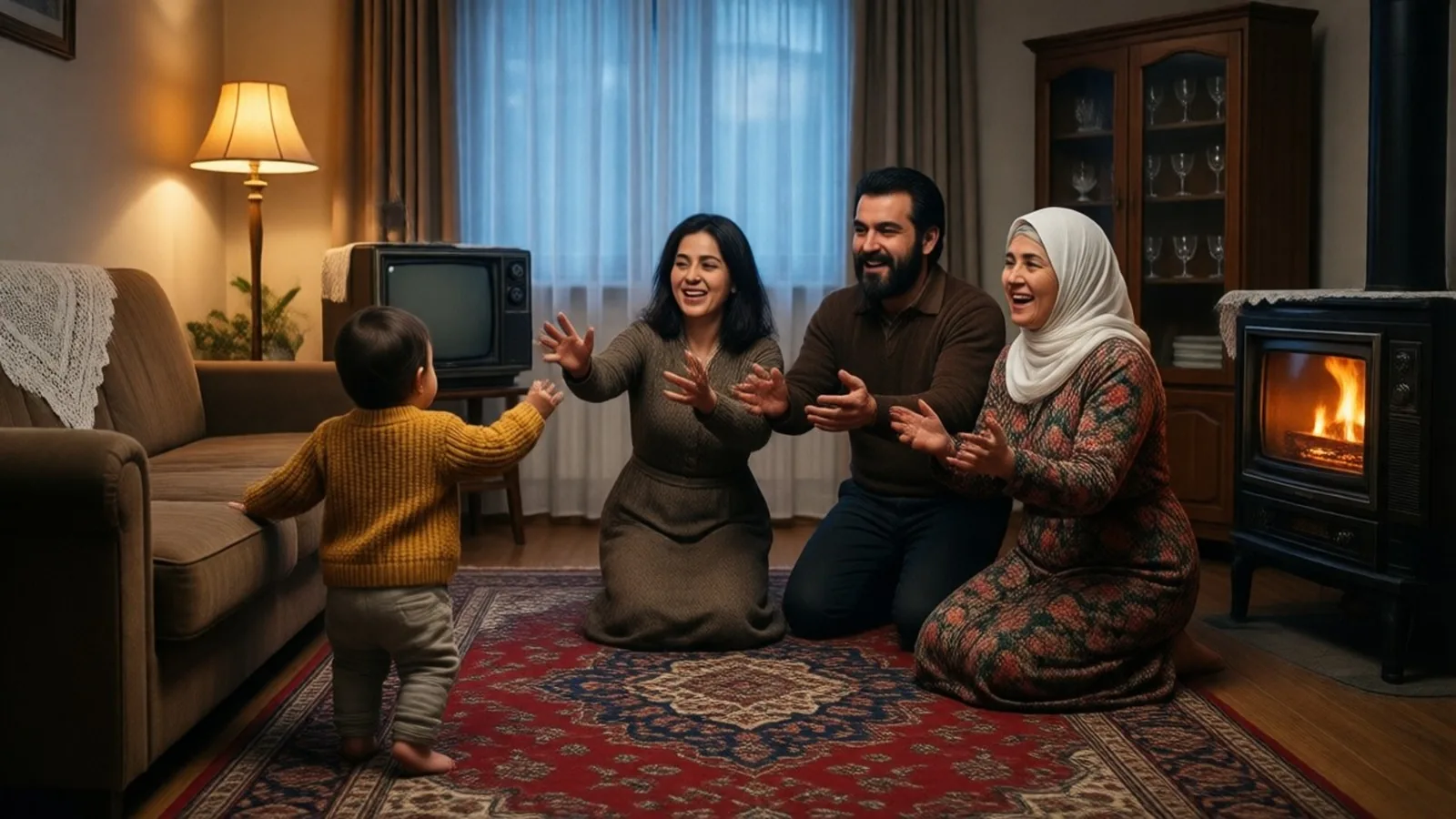
What is written has to show up in the pictures too. The same scene is drawn four times, and which objects appear in which decade lives in its own dictionary. We described that in How to draw a life. The living room on the cover is an example: a tube television and a wood stove, a home from the eighties.
Why we went to this trouble
If a life game acts like it is "everyone's life", the living room of someone born in 1980 cannot be the living room of someone born in 2010. If it is, the player notices fast and stops believing. And you cannot ask someone to read a life they no longer believe.
We are not done. We have a scanning tool that catches decade mismatches, but there are a lot of scenes, and a single phone in the wrong decade can still stand out. If a sentence landed in the wrong decade, write to us at support@yaspergames.com.